When I first thought about writing this post, I simply wanted to highlight a few flaws in how rewards affect child motivation. I had no idea I was stepping into one of the most debated—and emotionally charged—topics in parenting and education.
During my time in child care, I saw every approach imaginable. Some teachers used sticker charts. Others handed out “accomplishment cards.” Some rejected rewards altogether, insisting children should be driven by internal satisfaction, not external prizes. I remember being told in training, “Let children feel pride from their own progress.” I agreed with that. But then I worked with a teacher who had over 20 years of experience in the toddler room—she used stickers for potty training, and it worked. I was okay with that too.
The more I observed, the more I wondered:
Are rewards helping or hurting?
I should have stopped there. But I didn’t.
I fell into the research rabbit hole.
Suddenly, I was knee-deep in articles, books, and theories. Even the experts didn’t agree. During a school assignment, I stumbled upon one PBIS article, it casually said, “Some researchers suggest that rewards…” and I remember thinking—why is this still a debate? Why can’t we all agree on what works?
My Personal Experience with Rewards
When I was a child playing soccer, I learned my teammate earned $1 from her dad for every goal she scored. I thought it sounded fun and motivating, so I asked my parents if we could do the same. Eventually, my dad offered the incentive during a tough game. We were losing, and I didn’t score.
No goal, no reward.
What started as a joyful game turned into a missed opportunity—and a harsh lesson. Even when you try your best, you might not get the reward. And suddenly, the motivation wasn’t joy or teamwork. It was money.
That moment taught me how easily external rewards can shift motivation away from the experience and toward the outcome.
What Is Intrinsic vs. Extrinsic Motivation?
Two major types of motivation help explain how rewards affect behavior:
Intrinsic Motivation
This is the desire to do something because it’s inherently enjoyable, satisfying, or meaningful.
Children with intrinsic motivation:
- Solve puzzles because they’re curious.
- Draw pictures because they enjoy it.
- Help clean up because it feels good to contribute.
Why it matters:
Intrinsic motivation supports creativity, persistence, and long-term engagement. These kids are learning because they want to—not because they expect a reward.
Extrinsic Motivation
This is when the desire to act comes from an outside source—like money, stickers, praise, or avoiding punishment.
Examples:
- A child shares to earn a treat.
- A student studies to get an A.
- A preschooler sits quietly to win a prize.
Why it matters:
Extrinsic motivation can be effective—especially for new or difficult behaviors. But over time, it may reduce a child’s internal drive if used too often or in the wrong way.
So… Do Rewards Help or Hurt?
The answer? It depends.
Rewards can be effective when used sparingly and intentionally. They can help reinforce new habits, encourage positive behavior, and provide structure. But to build lasting motivation, children need more than a sticker—they need purpose, connection, and the pride of knowing they did it themselves.
What the Research Says
Cameron & Pierce (2002): Rewards Aren’t the Enemy
Cameron and Pierce examined over 30 years of research on reward systems and found:
“Rewards do not deserve a bad reputation.”
They argue that when used thoughtfully and fairly, rewards do not reduce intrinsic motivation. Instead, they can enhance performance and enjoyment—especially when framed as positive reinforcement, not coercion.
Key distinction:
- Coercion = controlling behavior for the adult’s benefit.
- Positive reinforcement = supporting behavior for the child’s growth.
Ask yourself: Who benefits most from the reward—the adult or the child?
Alfie Kohn (2018): Use Caution with Rewards
In Punished By Rewards, Kohn warns that external motivators can backfire:
“The more we reward people for doing something, the more they tend to lose interest in whatever they had to do to get the reward.”
He argues that when children are rewarded for everything, they lose sight of internal satisfaction and start chasing prizes instead of purpose.
And he’s not wrong. When rewards replace emotional connection or thoughtful feedback, motivation shifts from meaning to merit.
Finding the Balance
While Cameron & Pierce and Kohn disagree in tone, they agree on one thing:
Overused or misused rewards can do harm.
So don’t throw out the concept—just use it wisely.
Be intentional. Be specific. Focus on growth.
PBIS: A Structured Middle Ground
The Positive Behavioral Interventions and Supports (PBIS) framework embraces rewards—not as bribes, but as tools for teaching expected behaviors.
“PBIS uses a system of supports and data-driven interventions, including recognition and reinforcement for positive behavior.” — Lee (n.d.), Understood.org
In PBIS, rewards are predictable, purposeful, and used to build skills—not manipulate behavior. Especially in early childhood, they help kids understand expectations and feel seen for their efforts.
Praise as a Verbal Reward (Morin, 2025)
Not all rewards are tangible. Sometimes, it’s how we talk to children that matters most.
In her article The Power of Effective Praise, Amanda Morin makes a clear point:
“Praise is most effective when it focuses on effort and improvement—not just results.”
Saying “You’re so smart!” may sound encouraging, but it attaches self-worth to outcomes. A more effective approach?
“You worked really hard on that puzzle. I saw how you didn’t give up.”
That’s the kind of feedback that reinforces intrinsic motivation, resilience, and confidence.
Final Thoughts: Motivation That Lasts
Reward systems are tools. Like any tool, they can build—or they can break.
Used with intention, rewards can guide, shape, and support a child’s growth. Used carelessly, they can distract from what truly matters: connection, confidence, and a love of learning.
How Rewards Affect Child Motivation
From my own experience playing soccer as a child, I learned that rewards offered at the wrong time—or for the wrong reasons—can do more harm than good. What began as motivation quickly became pressure, shifting the joy of playing into the disappointment of not “earning” a reward.
So before offering a sticker, a treat, or a dollar, pause and ask:
What am I rewarding—and why?
Because in the end, we’re not just shaping behavior.
We’re shaping people.
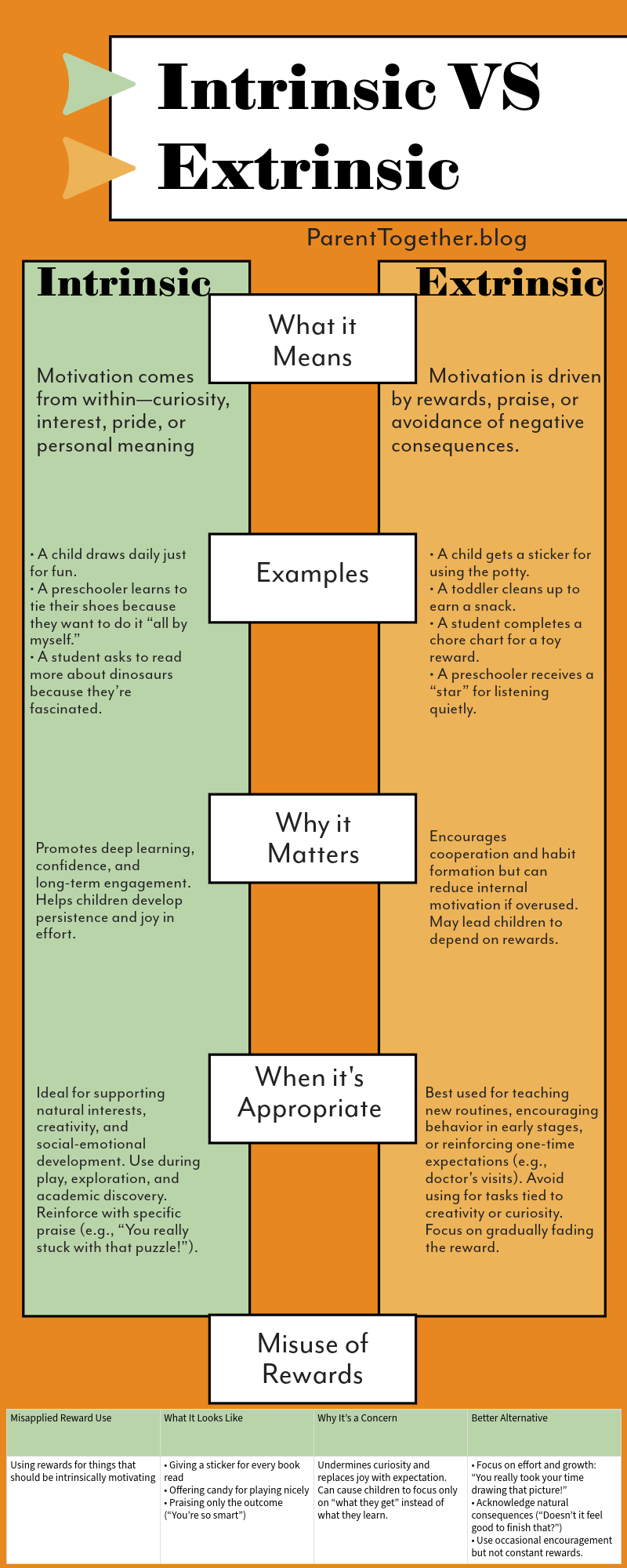
Free Resource: Intrinsic vs. Extrinsic Motivation Chart
I created a simple chart for both parents and educators to use as a visual reminder.
[Download the Intrinsic vs. Extrinsic Motivation Chart here]
Or check out a quick guideline below:
Chores as Intrinsic Motivation (ideal but gradual)
Children want to help because it makes them feel proud, capable, or connected.
Examples:
- A toddler wipes the table because it’s fun and helpful.
- A preschooler sorts laundry because they want to contribute.
- A child puts toys away because they like a clean space.
How to encourage this:
“You’re such a great helper—thanks for being part of our team.”
“Doesn’t it feel good to have your room clean?”
You’re reinforcing internal satisfaction—not just compliance.
Chores as Extrinsic Motivation (a common starting point)
Chores are tied to external rewards like treats, allowance, or screen time.
Examples:
- “Clean your room and you can have dessert.”
- “Take out the trash to earn your allowance.”
- “No tablet until the dishes are done.”
Use with care:
Extrinsic motivation can build routines, especially with reluctant kids—but if overused, it teaches children to focus on “What do I get?” instead of “What can I contribute?”
Best Practice: Balance & Transition
Start with rewards if necessary—but gradually fade them and build intrinsic ownership.
“Let’s use a sticker chart for now, and soon you’ll feel how good it is to do it on your own.”
Start with connection. Support the process. Celebrate the effort.
Use rewards only when they serve the child—not just the outcome.
References
Alfie Kohn. (2018). Punished By Rewards: Twenty-Fifth Anniversary Edition : The Trouble with Gold Stars, Incentive Plans, A’s, Praise, and Other Bribes. HarperOne.
Cameron, J., & Pierce, W. D. (2002). Rewards and intrinsic motivation : Resolving the controversy. Bloomsbury Publishing USA.
Lee, A. M., JD. (2025, March 25). What is PBIS? Understood. https://www.understood.org/en/articles/what-is-pbis
Morin, A. (2025, February 11). The power of effective praise: A guide for teachers. Understood. https://www.understood.org/en/articles/effective-praise-guide-for-teachers
Morin, A. (2025, February 11). Understanding behavior as communication: A teacher’s guide. Understood. https://www.understood.org/en/articles/understanding-behavior-as-communication-a-teachers-guide
Check out my other references for more information on child development: References
Also be sure to check out my Resources page for more printable content.