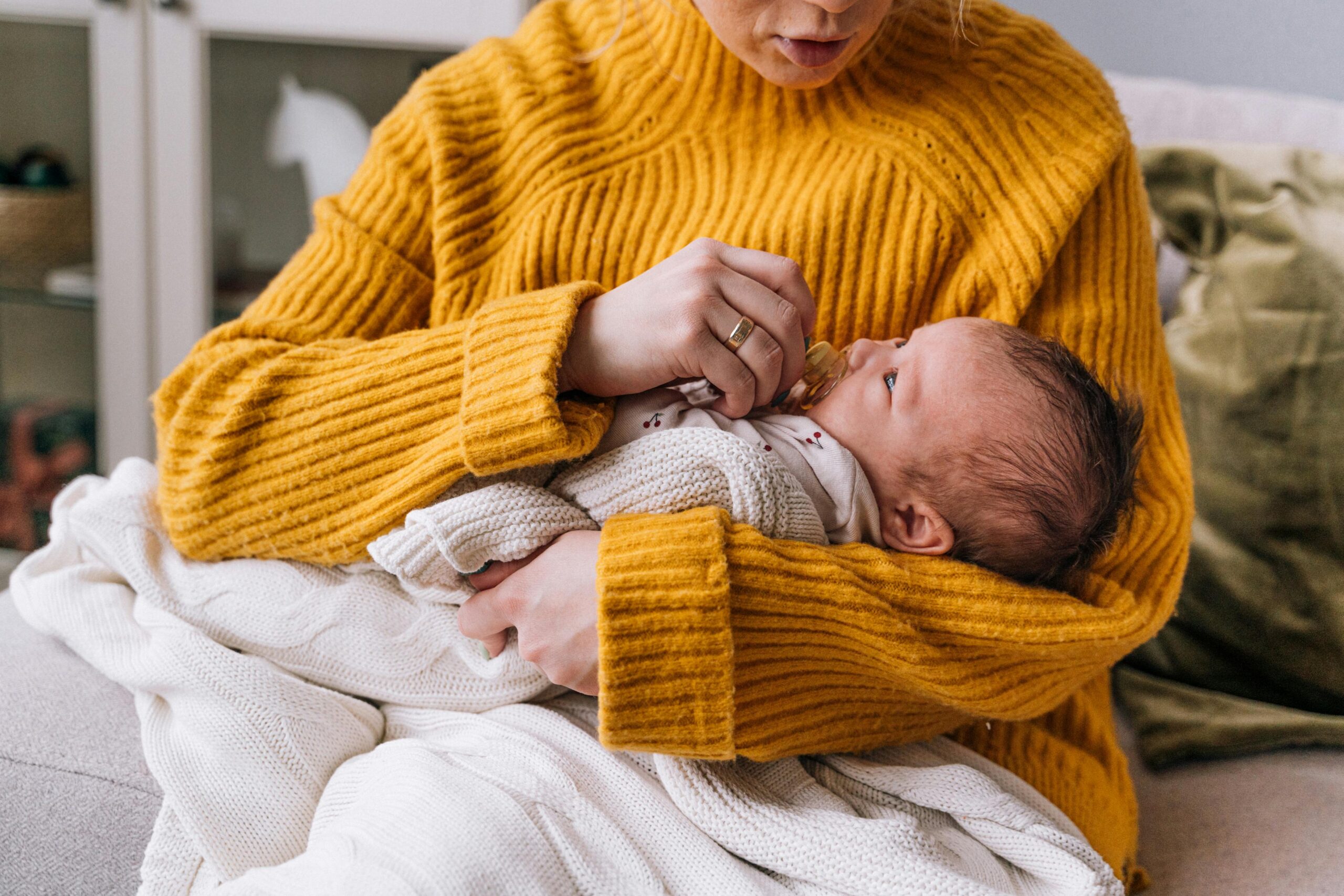
You’ve probably been given plenty of advice about pacifiers—some people swear by them, others say “never start.” The truth is, like most things in parenting, pacifiers are a tool. And tools work best when you know how, when, and why to use them. Pacifiers can offer comfort to babies and relief to parents, but they can also cause problems if used without a plan. The goal of this article is to help you understand the research behind pacifier use, enabling you to make an informed choice that works for your family.
Why Do We Use Them?
Pacifiers are one of the oldest and most widely used methods for soothing babies. Across Western countries, 75–85% of infants use pacifiers in their first year of life (American Academy of Family Physicians [AAFP], 2009). Parents most often reach for them to:
- Calm a crying or unsettled baby (78% of first-time mothers reported this)
- Help a child fall asleep (57%)
- Provide general soothing comfort (40%)
(Mauch et al., 2012)
There’s also an emotional side: pacifiers don’t just comfort babies—they can help parents feel calmer, too. A 2024 study of 428 mothers found that pacifier use was associated with lower parenting stress, improved parent–child dynamics, and more positive perceptions of a child’s mood (Mitev et al., 2024).
Pacifiers work because they satisfy an infant’s natural sucking reflex, which is present from birth and provides a sense of security (AAFP, 2009). Whether it’s falling asleep, easing discomfort during teething, or just helping your baby relax, the pacifier’s main job is to soothe.
Breastfeeding and Pacifiers
One of the biggest questions for new parents is: Will using a pacifier interfere with breastfeeding? The answer comes down to timing. Health experts, including the American Academy of Pediatrics (AAP), recommend waiting until breastfeeding is well established—usually around 3–4 weeks—before introducing a pacifier (AAP, 2021; Jaafar et al., 2016). This helps avoid “nipple confusion,” where a baby’s latch or feeding rhythm might be disrupted by switching too soon between breast and pacifier.
Early sucking is more than just comfort—it meets emotional needs and helps strengthen the muscles in the mouth, lips, and tongue that are crucial for both feeding and later speech development (Miller, 2022). Babies who are bottle-fed use less muscular effort to get milk than breastfed babies do, so they may benefit emotionally and physically from occasional non-nutritive sucking—such as with a pacifier—in their early months (Miller, 2022).
Pacifiers also have an advantage over thumb sucking in terms of oral health. They’re generally less damaging to developing teeth and are easier to wean from than thumbs, which can be a long-term habit (Neves et al., 2020). By introducing a pacifier at the right time, families can support both their baby’s feeding success and comfort needs.
Language Development
While pacifiers can be a great comfort tool, it’s essential to give babies and toddlers plenty of “mouth-free” time to practice sounds, babble, and work on early speech development. Toddlers learn language not just by hearing words but by moving their mouths and experimenting with sounds (Borrego et al., 2024). Suppose a pacifier is in the mouth for most of the day. In that case, it can limit opportunities for talking and reduce the back-and-forth interactions that are crucial for language development.
Pacifier use can also affect social communication skills. Research has found that when infants have a pacifier in their mouth, it’s harder for adults to read their facial expressions, such as smiles or distress cues—and harder for babies to mirror those expressions back (Rychlowska et al., 2014). These small exchanges are key for learning the rhythm, tone, and emotional meaning of language.
For this reason, many speech-language pathologists recommend reserving pacifiers for use during sleep times, moments of distress, or transitions once your child has passed the newborn stage. That way, you protect your child’s opportunity to play with sounds, share facial expressions, and build the foundation for clear speech.
Oral Fixations and Medical Benefits
Sucking is a natural reflex for newborns—it’s comforting, soothing, and helps babies regulate their emotions (AAFP, 2009). Pacifiers can support this need in healthy ways, and research has found some clear medical benefits:
- Reduced risk of SIDS — Offering a pacifier at naps and bedtime is associated with a lower risk of sudden infant death syndrome (AAP, 2022).
- Support for preterm infants — In the NICU, pacifiers can help premature babies transition more quickly from tube feeding to oral feeding, often shortening hospital stays (Pinelli & Symington, 2020).
- Pain relief — Pacifiers, especially when paired with a sweet solution, can help alleviate discomfort during procedures such as vaccinations or heel pricks (Carbajal et al., 2013).
Pacifiers can also satisfy an oral fixation in a way that’s easier to manage than thumbsucking, which can cause more lasting dental issues and is harder to stop (Neves et al., 2020). That said, long-term pacifier use—especially beyond the age of 2–3—can increase the risk of dental malocclusion, such as an open bite or crossbite (Neves et al., 2020). The key is to enjoy the benefits early on, while planning for a gentle and timely weaning process.
Appropriate Time Frame and Weaning
Pacifiers can be a helpful tool in the first year of life, but like any comfort aid, they work best when there’s a plan for when—and how—to let them go.
Most experts agree that pacifiers can be safely used during the first year, especially for soothing and for the potential SIDS protection they offer when used at naps and bedtime (AAP, 2022). After about 6 months, however, it’s wise to start limiting use to reduce the risk of middle ear infections (AAFP, 2009).
Dental experts, including the American Academy of Pediatric Dentistry (AAPD), recommend initiating the weaning process by around age 2 and stopping completely by age 3 to prevent lasting changes in tooth alignment (Neves et al., 2020). The longer a pacifier is used past this point, the greater the risk of malocclusion, such as an open bite or crossbite.
When it comes to weaning, research shows there’s no one “right” method—what works for one child may not work for another. In one caregiver study, 27–28% of parents found success with a gradual approach, such as limiting pacifier use to naps and bedtime, while about 25% used an abrupt “cold turkey” method (Mitev et al., 2024). Gradual weaning can be gentler for some children, especially when combined with comfort alternatives, such as a favorite blanket or stuffed animal.
A few parent-tested strategies include:
- Nap-and-bedtime only — Start by keeping the pacifier in the crib, not around the house.
- Trade for a comfort object — Replace the pacifier with a special stuffed animal or lovey.
- Use a countdown — Mark a calendar and talk about the upcoming “bye-bye binky” day.
- Celebrate the milestone — A small ritual, story, or reward can make the transition feel positive.
The key is consistency. Once you start limiting pacifier use, stick with it so your child understands the new routine and can adjust accordingly. This way, you protect the benefits pacifiers offer in infancy while avoiding the long-term risks of extended use.
Pacifiers in Daycare Settings
Pacifier use in childcare settings comes with its own unique set of considerations—policies, hygiene practices, and developmental goals that may be different from home routines. While pacifiers can be an essential comfort tool, in a group care environment, they require intentional management to ensure children remain safe, healthy, and make developmental progress (AAP, 2022).
As a long-time infant teacher, I loved watching the way children grow and adapt. Much of caregiving and parenting involves trial and error. While pacifiers may seem like a minor aspect of the classroom environment, they are still a transitional piece that needs to be taken seriously. In our infant room, which served children from 6 weeks to 18 months, I typically aimed to have them off the pacifier by 12 months old.
Once a child became mobile—whether crawling, scooting, or walking—the pacifier was no longer allowed during active play. This was both a safety measure (to prevent choking hazards) and a health precaution (to reduce cross-contamination, as babies tend to grab and put objects, including each other’s pacifiers, in their mouths). This helps promote language development, allows children to explore their environment without a “mouth plug,” and reduces the likelihood of pacifier-sharing between children (Borrego et al., 2024).
In our classroom
Pacifiers were reserved for naptime or to help a child settle into sleep. If a child cried for other reasons, we used alternative comfort strategies—like affection and attention for an injury, redirection for a social conflict, or walking them through sharing—rather than using the pacifier as a “quick fix” that masked the real need. This approach helped children learn coping skills and social problem-solving without relying too heavily on the pacifier.
Between 14 and 16 months, I would work to completely remove the pacifier from the child’s daily routine so they were prepared for the toddler room, where pacifiers are typically not allowed. Some children transitioned in a week; others needed several months. The key was starting early, practicing consistently, and communicating with families so home and school routines matched.
We also followed strict hygiene practices. Each pacifier had to be labeled with the child’s name to avoid mix-ups. If it was dropped, it was washed with soap and water, sanitized with a non-toxic solution, and left to air-dry in a breathable space—never sealed in a container without ventilation, which can trap moisture and encourage mold growth. Pacifiers were stored out of reach of children until needed, whether in a cubby or hung up to dry.
In my experience, this thoughtful, consistent approach not only kept children safe but also made the transition away from pacifiers smoother—both for the child and for the parents.
In Conclusion
Pacifiers can offer comfort, soothe babies, and even provide medical benefits, such as lowering the risk of SIDS—when used intentionally. The key is balance: introduce at the right time, limit use as children grow, and wean before it impacts speech or dental health.
From my years in the infant room, I’ve seen that every child’s timeline is different. With gentle guidance, consistent routines, and clear communication between home and childcare, pacifiers can serve their purpose and then make a smooth exit. Used thoughtfully, they’re not a barrier to growth but a tool that supports both comfort and development.
Pacifiers aren’t “good” or “bad”—they’re just one of many tools in your parenting toolbox. When used with intention, they can bring comfort without getting in the way of growth, allowing your child to explore the world with both security and independence.
References
American Academy of Family Physicians. (2009). Thumb-sucking and pacifier use. American Family Physician, 79(8), 681–685. https://www.aafp.org/pubs/afp/issues/2009/0415/p681.html
American Academy of Pediatrics. (2021). Policy statement: Breastfeeding and the use of human milk. Pediatrics, 129(3), e827–e841. https://doi.org/10.1542/peds.2011-3552
American Academy of Pediatrics. (2022). Sleep-related infant deaths: Updated 2022 recommendations for reducing infant deaths in the sleep environment. Pediatrics, 150(1), e2022057990. https://doi.org/10.1542/peds.2022-057990
Borrego, M., Pérez, M., García, A., & López, A. (2024). Pacifier use and speech development in toddlers. Developmental Science, 27(3), e13477. https://doi.org/10.1111/desc.13477
Carbajal, R., Chauvet, X., Couderc, S., & Olivier-Martin, M. (2013). Randomised trial of analgesic effects of sucrose, glucose, and pacifiers in term neonates. BMJ, 319(7222), 1393–1397. https://doi.org/10.1136/bmj.319.7222.1393
Jaafar, S. H., Ho, J. J., & Jahanfar, S. (2016). Pacifier use versus no pacifier use in breastfeeding term infants for increasing duration of breastfeeding. Cochrane Database of Systematic Reviews, 2016(11), CD007202. https://doi.org/10.1002/14651858.CD007202.pub4
Mauch, C. E., Scott, J. A., Magarey, A. M., & Daniels, L. A. (2012). Predictors of and reasons for pacifier use in first-time mothers: An observational study. BMC Pediatrics, 12(1), 7. https://doi.org/10.1186/1471-2431-12-7
Miller, D. F. (2022). Positive child guidance (9th ed.). Cengage Learning.
Mitev, M., Rigo, J., Sitar, A., & Fidler Mis, N. (2024). The who, when and why of pacifier use. Pediatric Research. https://doi.org/10.1038/s41390-024-03540-6
Neves, L. T., Lopes, L. B., de Oliveira, A. M., & Ribeiro, L. B. (2020). Effects of pacifier sucking on dentofacial development in children: A systematic review. Dental Press Journal of Orthodontics, 25(3), 47.e1–47.e10. https://doi.org/10.1590/2177-6709.25.3.47.e1-10.onl
Pinelli, J., & Symington, A. (2020). Non-nutritive sucking for promoting physiologic stability and nutrition in preterm infants. Cochrane Database of Systematic Reviews, 2020(4), CD001071. https://doi.org/10.1002/14651858.CD001071.pub3
Rychlowska, M., Korb, S., Brauer, J., Droit-Volet, S., & Anders, S. (2014). Pacifier use affects adults’ responses to infants’ emotions. Basic and Applied Social Psychology, 36(6), 569–576. https://doi.org/10.1080/01973533.2014.958250
For More Resources
For more references and resources, check out my References page
Featured Photo
Photo by Antoni Shkraba Studio: https://www.pexels.com/photo/woman-in-yellow-knit-sweater-carrying-baby-6134679/
