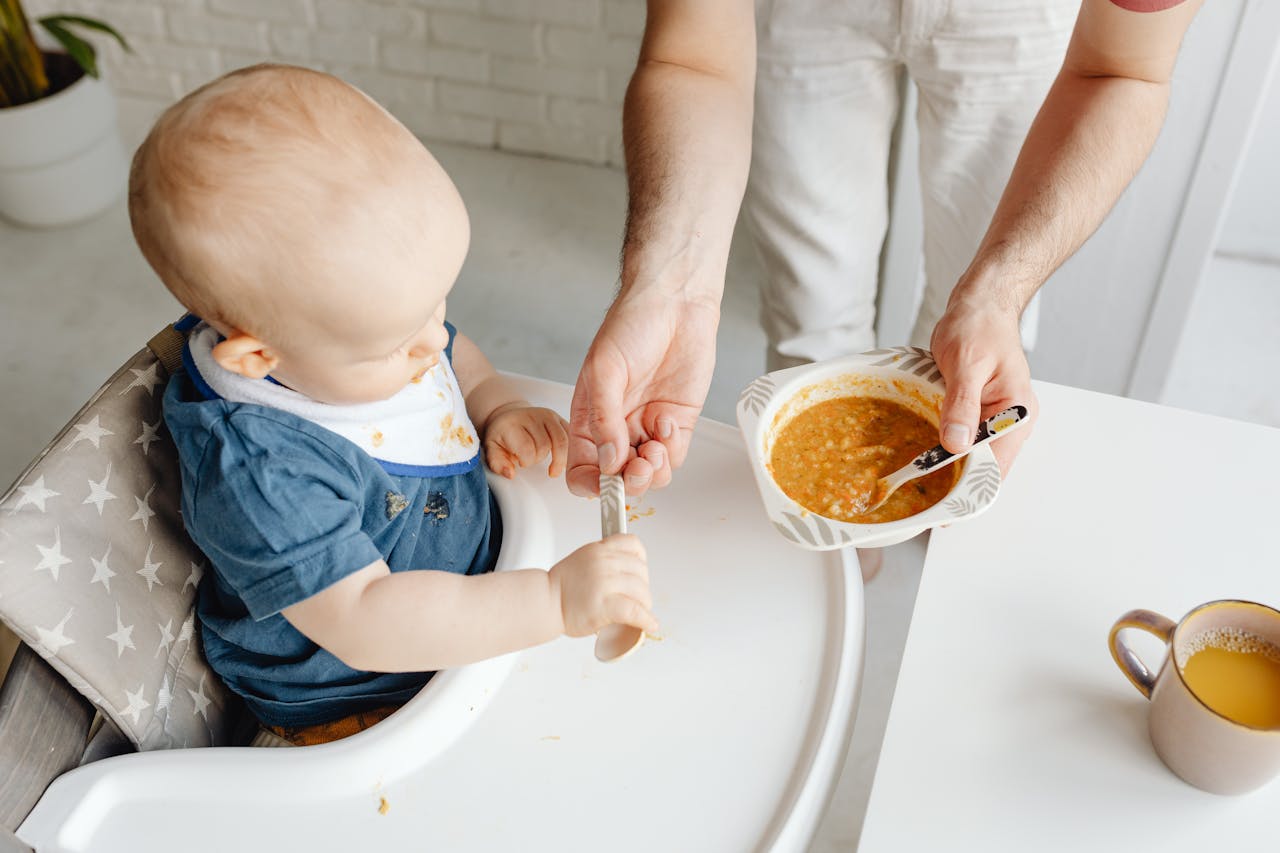
Feeding your baby in the first year goes beyond nutrition. It lays the foundation for growth, immunity, independence, and early social-emotional development. For many parents, this stage brings worry: Starting solids, can babies have water, honey, or sugar, and allergy concerns.
This guide combines expert recommendations with practical advice so you can feel confident as you nourish your little one. Be sure to check out my post about Fueling Growth: The 6 Essential Nutrients for Healthy Child Development.
Breastfeeding
The World Health Organization (WHO, 2023) and American Academy of Pediatrics (AAP, 2022) recommend exclusive breastfeeding for about the first 6 months of life. Breast milk provides ideal nutrition. It contains the perfect balance of proteins, fats, vitamins, and antibodies to support immunity and development (Victora et al., 2016).
Breastfeeding also promotes jaw and muscle development, reduces the risk of infections, and strengthens the bond between parent and child. Of course, breastfeeding can present challenges, from latching difficulties to concerns about supply. In these cases, lactation consultants, support groups, and pumping strategies can provide valuable assistance.
Transition Tip: Preparing for Daycare
If you plan to have your infant in daycare, it’s helpful to introduce bottle-feeding alongside breastfeeding early on. This is, of course, after they have been breastfeeding for a couple of weeks and latch on easily. Still, ask your lactation consultant first. Offering breast milk from both the breast and the bottle helps babies adjust to different feeding methods, making the transition to childcare much smoother. Some parents choose to pump and provide bottles, while others arrange to visit the daycare to nurse directly. Both approaches can be effective—what matters most is consistency and preparation before the first significant drop-off (American Academy of Pediatrics, 2020).
Bottle-Feeding Bonding Matters
Whether you are offering breast milk or formula in a bottle, it’s important to remain present and engaged during feeding. Hold your baby close, maintain eye contact, and talk or sing softly. This builds trust, strengthens attachment, and supports early language development. Feeding time is a chance to connect, not just a time to fill a tummy (Black & Aboud, 2011).
Bottle Safety Tip
Only breast milk or formula should go into your baby’s bottle. Do not add cereal, juice, honey, or sweeteners. Adding extras can increase the risk of choking, upset digestion, and lead to unnecessary sugar exposure. It also prevents babies from learning to regulate hunger and fullness, since the texture and calorie density of the milk changes (AAP, 2020).
Some parents are advised that adding cereal to their babies’ bottles will help them sleep longer, but research indicates this is not the case—and it may even increase the risk of obesity and disrupt healthy feeding patterns later on (HealthyChildren.org, 2020). Cereal and other solids should always be introduced by spoon once your baby is developmentally ready, not through a bottle.
Similarly, juice should never be placed in a bottle, even after the first year. Sucking on juice for long periods exposes a baby’s teeth to sugar and acid, leading to tooth decay. If juice is offered after 12 months, it should be served in a cup, in very small amounts, and should never replace milk or water.
Formula Feeding
Infant formula is a safe, nutritionally complete alternative to breast milk. Parents may choose formula for medical, personal, or lifestyle reasons, and modern formulas are carefully regulated to ensure they support healthy growth (CDC, 2024).
Safe preparation is critical. Because powdered formula is not sterile, it should be mixed with clean, safe water and stored correctly to prevent contamination. Over-diluting can deprive infants of necessary calories, while leaving formula out too long can allow harmful bacteria to grow (FDA, 2023).
Water
Babies under 6 months should not be given water. Their kidneys are not mature enough, and even small amounts can interfere with nutrient absorption or, in rare cases, lead to water intoxication (AAP, 2020). After 6 months, once solids are introduced, small sips of water may be offered, but breast milk or formula should remain the primary source of hydration throughout the first year (CDC, 2024).
Juice is not recommended for infants under 12 months. Even 100% fruit juice contains concentrated sugars that can displace more nutritious foods, contribute to tooth decay, and increase the risk of obesity. After age one, if parents choose to introduce juice, it should be limited to no more than 4 ounces per day and served in a cup, not a bottle (AAP, 2017).
Daycare and Bottles: What Parents Should Know
If your baby attends daycare during the first year, there are strict bottle procedures to keep feeding safe and organized:
- Only Breast Milk or Formula: Just like at home, bottles sent to daycare should only contain breast milk or formula—no cereal, juice, honey, sweeteners, or melatonin.
- Labeling Requirements: Each bottle must include:
- Whether it contains human milk or formula
- The date it was made or expressed
- If frozen, the date it was thawed
- Your child’s full name
- A piece of color-coded tape assigned specifically to your child
- Daycare teachers must sit down while feeding a child. This is for safety to prevent choking, to form bonds, and avoid any accidents.
Bottles come already prepared by the parent
- If Bottles are glass, they must be protected with a silicone sleeve in case of droppage. Some daycares don’t allow glass so be mindful.
- Storage: Bottles are stored in your child’s own labeled bin in the refrigerator, which is also color-coded for easy identification and to prevent mix-ups.
- Sanitation: Teachers and caregivers are only permitted to rinse bottles after feeding; they are not allowed to fully wash or sanitize bottle parts. Parents are responsible for thoroughly cleaning and sanitizing bottles at home before sending them back to daycare.
- Bottle Handling:
- Human milk should be stirred, not shaken, to protect delicate proteins.
- Formula can be shaken safely for mixing.
- Bottles should not be warmed for longer than 4–5 minutes, as overheating can damage nutrients and pose safety risks.
- Discard Policy:
- Bottles must be labeled with the time they are removed from the refrigerator. From that point, they are good for only one hour.
- If the bottle contains formula, any unfinished portion is discarded immediately after one hour.
- If the bottle contains human milk, any unfinished portion is labeled “not for consumption.” It is then sent home with parents at the end of the day.
These procedures protect infants’ health, ensure the right milk goes to the right child, and provide consistency between home and daycare.
Bottle Warmer Safety:
There is ongoing concern regarding the use of bottle warmers in daycare environments. Research highlights that toddler scald burns are alarmingly common. In fact, 44,395 children under 18 months suffered burn injuries over a two-year period. Many of these injuries were caused by hot water and heating devices (Finney Injury Law, n.d.; Frontiers in Pediatrics, 2023). Legal investigations have also documented severe cases. For example, one infant sustained life-altering injuries after a bottle warmer spilled boiling water in a daycare (Button Law Firm, n.d.). These risks emphasize why many experts and parents advocate for safer alternatives. A safer method is preparing bottles under running warm water instead of relying on electric heating devices.
- Personal Recommendation: I would not send my child to a daycare that uses bottle warmers. Instead, at home, you can safely warm bottles by holding them under warm running water and practice this for when they go to daycare.
- Nutritional Perspective: There’s no scientific evidence that warmed bottles provide any nutritional benefits over room-temperature milk or formula. Warming is strictly a preference, and no preference justifies risking your child’s safety (Nationwide, n.d.).
Introducing Solids
Most babies are ready for solids around 6 months, although readiness depends more on development than age. Signs your baby may be ready include being able to sit up with minimal support, having good head and neck control, showing interest in your food, and no longer pushing food out of the mouth with the tongue-thrust reflex (WHO, 2023).
First foods should be rich in iron, such as fortified baby cereal, puréed meats, beans, or lentils (Schwarz et al., 2021). Jar foods and smooth homemade purées are safe to begin once your baby can sit supported and swallow with control.
When introducing new foods:
- Offer one new food at a time and wait at least 24 hours (some experts suggest 3 days) before adding another. This makes it easier to identify potential allergies (Greer et al., 2019).
- Watch for signs of reaction: rash, vomiting, diarrhea, or swelling.
Foods requiring special caution:
- Honey: Never give honey before 12 months due to the risk of infant botulism—even “natural” or raw honey is unsafe (CDC, 2023).
- Cow’s milk as a drink: Avoid until after 12 months, though yogurt and cheese may be introduced earlier (AAP, 2020).
- Water: Avoid before 6 months.
High-Allergy Foods
The AAP now recommends introducing allergenic foods early—around 6 months—rather than delaying, as early exposure may help reduce the risk of allergy (Greer et al., 2019). Introduce one at a time, in small amounts, while monitoring closely.
High-allergy foods include:
- Cow’s milk (yogurt, cheese; not as a drink before 12 months)
- Eggs (yolk and white)
- Peanuts (thinned peanut butter or powdered form mixed into purées)
- Tree nuts (finely ground or nut butters, never whole)
- Soy (tofu, soy yogurt, etc.)
- Wheat (bread, pasta, cereals)
- Fish (such as salmon, cod)
- Shellfish (shrimp, crab, lobster)
- Sesame (tahini, hummus, sesame oil)
Safety Tip: If your family has a strong history of allergies, or if your child has had a reaction before, consider introducing new high-allergy foods in a safe environment. Some parents find peace of mind by offering the first bites near a hospital or in front of an emergency room, just in case medical help is needed quickly. Always consult with your pediatrician or allergist for personalized guidance on this approach.
Daycare Policy Note: Most licensed child care centers follow strict rules that prohibit staff from introducing any new food that has not already been introduced at home. This protects children in the event of allergic reactions and places responsibility on families to ensure that babies have been safely exposed to a wide variety of foods before entering care. That’s why the 6–12 month window is so critical—parents should take advantage of this time to introduce as many safe, age-appropriate foods as possible. By 12 months, children typically transition fully to table foods and begin drinking whole (full-fat) cow’s milk, which supports brain growth and nutrition during the toddler years (AAP, 2020).
Daycare and Daily Reports
In most infant rooms, parents are required to fill out a daily sheet with basic information about their child’s routine. This often includes the last time the infant slept, the last time they were fed, the type of bottle they had last, and their most recent diaper change. This information helps teachers plan the infant’s day more effectively and ensures consistency between home and daycare (National Association for the Education of Young Children [NAEYC], 2020). Daily reports also strengthen communication and build trust between families and educators by ensuring that caregivers are aware of the child’s immediate needs and recent care.
In addition to daily reports, daycare centers should also maintain individualized infant feeding plans tailored to each child’s developmental stage. These typically outline guidelines for feeding infants from 0–6 months (exclusive breastfeeding or formula feeding) and from 6–12 months (introduction of solids while maintaining breastfeeding or formula feeding as the primary source of nutrition). Feeding plans are updated as the child grows, helping ensure that all caregivers follow consistent practices aligned with both family preferences and pediatric recommendations (U.S. Department of Agriculture [USDA], 2023).
Exploration, Independence, and Self-Feeding
Starting solids is also the beginning of a baby’s exploration of food. At first, they may push purées around with their tongue, make faces, or play with textures more than they actually eat. This is all part of learning (Rapley & Murkett, 2010).
As motor skills improve, encourage independent attempts at self-feeding. Offer safe finger foods (such as soft fruits, cooked vegetables, or small pieces of cheese) and provide infant spoons they can practice with, even if it gets messy. These experiences strengthen hand-eye coordination, fine motor skills, and confidence (Carruth et al., 2004).
Eventually, children progress toward self-feeding with utensils and drinking from open or straw cups. This journey takes patience, but fostering independence at the table supports not only nutrition but also problem-solving, persistence, and a positive relationship with food.
Timeline of Food Progression in the First Year
Feeding is a gradual journey, moving from smooth textures to more challenging ones as your baby’s oral and motor skills develop. While every child progresses at their own pace, here is a general guideline:
- 0–6 months → Breast milk or formula only. No solids, water, or juice.
- Around 6 months → Begin with smooth purées and single-ingredient jar foods (vegetables, fruits, fortified cereals, puréed meats/beans). Introduce one new food at a time, waiting at least 24 hours.
- 6–8 months → Progress to thicker purées and mashed foods. Introduce soft finger foods, such as avocado, banana, scrambled eggs, or small pieces of cooked vegetables. Offer baby spoons for practice.
- 8–10 months → Try finely chopped or mashed versions of family foods. Add protein options like small flakes of fish, shredded chicken, or tofu. Encourage self-feeding with finger foods.
- 10–12 months → Introduce more textured table foods, cut into small, bite-sized pieces. Babies may start to self-feed more regularly and can begin learning to drink from a straw or open cups.
- After 12 months → Transition toward family meals with modifications for safety (no whole nuts, grapes, hot dogs, or hard chunks). Whole milk may be introduced if not breastfeeding/formula-feeding.
Avoid screen time during meals, as it interferes with bonding and responsive feeding (AAP, 2016). Also, steer clear of added sugars in the first two years—early exposure increases the risk of obesity and unhealthy eating habits later in life (Dietary Guidelines for Americans, 2020–2025).
Feeding as a Developmental Experience
Feeding is not just about nutrition—it’s about learning, bonding, and trust. Babies build social-emotional skills when caregivers respond to their cues: leaning forward for more, turning away when full, or reaching for a spoon.
This approach, known as responsive feeding, helps children develop self-regulation, reduces mealtime stress, and may even lower the risk of obesity and picky eating later in life (Black & Aboud, 2011). Eye contact, gentle encouragement, and conversation during feeding all foster connection and early language skills.
One powerful way to support communication during meals is by teaching basic baby sign language. Simple signs, such as “more,” “all done,” “milk,” “eat,” and “water,” allow infants to express their needs before they can speak. This not only reduces frustration but also builds a bridge between language and social interaction (Goodwyn et al., 2000).
As babies grow into toddlers, families can also introduce family-style dining—sitting together at the table, sharing food in small portions, and allowing little ones to serve themselves with guidance. This practice encourages independence, motor skill development, and social learning (Benjamin Neelon & Briley, 2011). Children observe positive mealtime behaviors, try new foods alongside their caregivers, and establish early routines centered on community and sharing.
Professional Guidance
Every baby is different, and feeding decisions should always be made with your child’s unique needs in mind. Consult your pediatrician or an infant nutritionist for personalized advice—especially if your child has growth concerns, developmental delays, eczema, or a family history of allergies (CDC, 2024).
Conclusion
The first year of feeding is about building a foundation for lifelong health. While breast milk or formula remains the core of infant nutrition, introducing solids around 6 months opens the door to growth, exploration, independence, and shared family experiences.
Remember:
- No water before 6 months.
- No honey before 12 months.
- No juice before 12 months.
- Do not put cereal, juice, or sweeteners in bottles.
- Introduce one food at a time, waiting at least 24 hours.
- Encourage exploration and self-feeding.
- Avoid screens and added sugar in the first two years.
- Prepare for daycare transitions by introducing a bottle once breastfeeding is established.
- Use the 6–12 month window to safely try as many new foods as possible before daycare and the switch to full solids and whole milk.
Above all, enjoy the journey. Feeding your baby is not only nourishing their body but also nurturing their trust, independence, and joy.
References
American Academy of Pediatrics. (2022). Infant food and feeding. HealthyChildren.org. https://www.healthychildren.org/English/ages-stages/baby/feeding-nutrition/Pages/default.aspx
American Academy of Pediatrics. (2023). Fruit juice in infants, children, and adolescents: Current recommendations. Pediatrics, 149(6), e2021052228. https://doi.org/10.1542/peds.2021-052228
Button Law Firm. (n.d.). Daycare burn injuries from bottle warmers. https://www.buttonlawfirm.com/blog/daycare-burn-injuries-from-bottle-warmers.cfm
Centers for Disease Control and Prevention. (2023). When, what, and how to introduce solid foods. https://www.cdc.gov/infant-toddler-nutrition/foods-and-drinks/when-what-and-how-to-introduce-solid-foods.html
Centers for Disease Control and Prevention. (2024). Infant and toddler nutrition: Cow’s milk and milk alternatives. https://www.cdc.gov/infant-toddler-nutrition/foods-and-drinks/cows-milk-and-milk-alternatives.html
Finney Injury Law. (n.d.). Burn injury statistics. https://finneyinjurylaw.com/burn-injury-statistics
Frontiers in Pediatrics. (2023). Scald burns in infants and toddlers: A two-year review of cases and prevention strategies. Frontiers in Pediatrics, 11, 1179823. https://doi.org/10.3389/fped.2023.1179823
National Institute of Child Health and Human Development. (2020). Infant feeding and nutrition. https://www.nichd.nih.gov/health/topics/infantcare/conditioninfo/infant-nutrition
World Health Organization. (2023). Infant and young child feeding: Key facts. https://www.who.int/news-room/fact-sheets/detail/infant-and-young-child-feeding
Featured Image:
Photo by Photo By: Kaboompics.com: https://www.pexels.com/photo/a-boy-holding-a-spoon-7946745/
