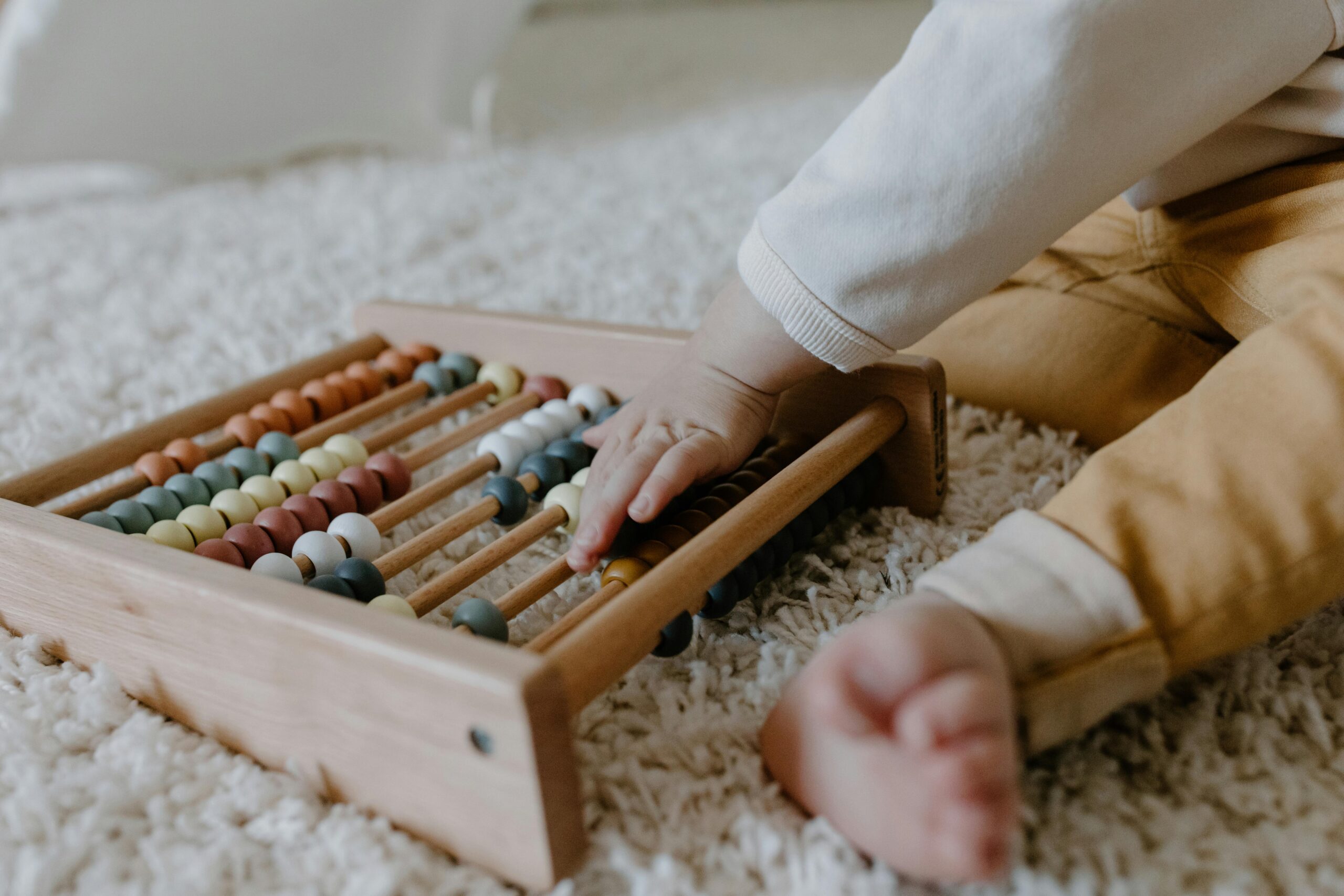
When I worked as an infant teacher, parent–teacher conferences were mandatory. More than once, a parent would laugh and ask, “What do you need to report to us—whether our child poops or if they’re learning baby algebra?” I always smiled and had a lighthearted retort ready, but when it came time for sit-downs, I explained what I actually do as a teacher. I walked parents through how I observe development, what milestones I look for, and what to expect in the months and years to come.
At first, many parents were skeptical. But when I showed them real proof of progress—photos, portfolios, and observations—they began to see just how much was happening beneath the surface. Their minds opened to the possibilities of what their children were capable of learning, even in the earliest years.
In this series, The 10 Developmental Domains Every Parent Should Know (and How to Support Them), I’ve already introduced the developmental domains and what they mean for your child. Now, I want to break each one down in more detail, starting with one of my favorites: Mathematics.
What Do We Mean by “Math” in the Early Years?
When you hear “math,” your mind may jump to 2+2, algebra, or fractions. Those are, of course, important—but they belong to the academic side of mathematics that comes later in school.
For infants through five-year-olds, math appears in a very different form. It’s about:
- Size and shape
- Spatial awareness
- Concepts like full, empty, or half
- Patterns and classification skills
- Sorting and comparing
- Early counting
These are the building blocks of mathematical thinking, and they develop long before a child ever picks up a pencil to solve an equation.
Why It Matters
Before we dive into age groups, I want to reiterate a point from my earlier post: all developmental domains intersect and support one another. When we focus on one area, such as math, we’re also strengthening cognitive skills, language, motor development, and even social-emotional growth.
For example, when a toddler pours water from one cup to another, they’re not just exploring measurement—they’re building fine motor control, testing problem-solving skills, and learning language as you narrate what’s happening. Math in the early years isn’t isolated—it’s woven into everything children do.
Infants (0–12 Months): Math in Everyday Moments
When we think about babies, math usually isn’t the first thing that comes to mind. Yet, from the very beginning, infants explore the world through patterns, quantities, and relationships. Whether it’s reaching for a toy, noticing when a bottle is empty, or giggling at the repetition of peek-a-boo, babies are already laying the foundation for future math learning (Frye et al., 2013).
Why this matters for baby brains (and later math):
- Math grows from multiple capacities working together. Research indicates that language, memory, and cognitive skills collectively strongly predict early math growth, accounting for nearly two-thirds of the variance in young children’s math abilities (Aragón, Navarro, Aguilar, Cerda, & García-Sedeño, 2016). Variance is just a research word for the differences we see among children’s abilities. When scientists say that language and memory account for most of the variance, it means those skills explain why some children pick up math more quickly than others. For parents, this matters because it demonstrates the significant impact of everyday talking, reading, and playful memory games on later math success.
- Home interactions shape math. Everyday input from parents—such as using math words (“more milk,” “all gone,” “two socks”)—supports both math and vocabulary growth by connecting concepts with lived experiences (Li, Chen, Rosales, Xu, Looney, & Zhou, 2025). Lived experience refers to the real, everyday moments children encounter in their world. For babies, that could be finishing a bottle, stacking blocks, or dropping food from a high chair. These experiences matter because they make abstract ideas—like “empty” or “two”—concrete and meaningful.
- Opportunities matter early. Gaps in early learning experiences, even before kindergarten, can widen disparities in school readiness, highlighting the importance of integrating math into daily infant care (Magnuson, Meyers, Ruhm, & Waldfogel, 2004).
What early math looks like with infants:
- Playing peek-a-boo teaches object permanence, helping babies understand that things exist even when out of sight—a critical logical step toward quantity and comparison (Frye et al., 2013).
- Watching you shake a rattle and realizing the sound happens every time builds cause-and-effect reasoning, a foundation for problem-solving (Jung & Conderman, 2025).
- Exploring toys of different sizes and shapes fosters spatial awareness and comparison skills (Teaching Strategies, 2023).
- Hearing adults narrate with math words—“Your bottle is empty, let’s fill it up”—strengthens the connection between language and quantity (Li et al., 2025).
How parents can support math development:
- Narrate routines: Use math vocabulary during everyday care. Say things like “two socks,” “cup is full,” or “all gone” to connect language with math ideas (Li et al., 2025).
- Offer safe objects to compare: Nesting cups, stacking rings, or bowls of different sizes give infants opportunities to manipulate, compare, and explore (Teaching Strategies, 2023).
- Play predictable games: Repetition and pattern-based games like peek-a-boo or “up and down” highlight sequence, cause-and-effect, and predictability (Frye et al., 2013).
- Sing and clap: Number rhymes and simple clapping games expose babies to rhythm and pattern, which later connect to counting and sequencing (Frye et al., 2013).
- Observe and respond: Notice what your baby enjoys—do they reach for larger objects, or smile when something repeats? Following their lead allows you to scaffold their learning in playful, meaningful ways (Teaching Strategies, 2023).
The big picture:
Math in infancy isn’t about flashcards or equations—it’s about experiences that engage the senses, encourage exploration, and build brain pathways for reasoning. By embedding math talk and playful comparisons into everyday routines, parents give babies not just a foundation for math, but also for language, cognition, and problem-solving across all developmental domains (Teaching Strategies, 2023; Aragón et al., 2016).
Toddlers (1–3 Years): Sorting, Stacking, Puzzles, and Comparing
Toddlers are natural explorers. They dump out bins of toys, line up cars, and try to climb into boxes that are clearly too small. What appears to be chaos is actually math in action: toddlers are testing size, shape, space, and quantity every single day (Teaching Strategies, 2023).
Why this matters for toddler brains (and later math):
- Hands-on play builds core math skills. Studies show that early math skills develop not from memorizing numbers, but from opportunities to compare, sort, and manipulate objects (Scalise, Pak, Arrington, & Ramani, 2025). These hands-on experiences allow toddlers to connect what they feel and see to abstract concepts like “bigger” or “more.”
- Teacher and parent beliefs matter. Research on early math instruction highlights that when adults feel confident about supporting math, children engage more deeply and show stronger growth (Scalise et al., 2025). This tells us that toddlers don’t need “perfect” math lessons—just enthusiastic adults who point out math in everyday life.
- Early skills predict later success. A predictive model found that toddlers’ ability to sort, classify, and recognize patterns is strongly related to their performance in later math learning (Aragón, Navarro, Aguilar, Cerda, & García-Sedeño, 2016). These skills are like puzzle pieces—when they fit together early, they support smoother growth in school.
- Problem-solving starts here. Even at this age, toddlers benefit from playful problem-solving—like figuring out how to get a toy out of a box or where a puzzle piece belongs. Supporting problem-solving early builds persistence and flexible thinking, which are critical for later math achievement (Jung & Conderman, 2025).
What early math looks like with toddlers:
- Solving simple puzzles teaches spatial reasoning, shape recognition, and persistence—math concepts wrapped in play (Teaching Strategies, 2023).
- Sorting and classifying toys by color, shape, or size (Aragón et al., 2016).
- Stacking blocks or filling and dumping containers, which teaches volume and comparison (Teaching Strategies, 2023).
- Pointing out “more” or “less” when sharing snacks or pouring water into cups (Li, Chen, Rosales, Xu, Looney, & Zhou, 2025).
- Recognizing patterns in songs, clapping rhythms, or simple routines (“wash hands, then eat”).
How parents can support math development:
- Introduce puzzles: Start with simple knob puzzles or shape sorters. Narrate with math words: “This piece is a triangle. Where does it fit?” (Teaching Strategies, 2023).
- Encourage sorting games: Use socks, blocks, or leaves from outside and ask, “Which ones are the same? Which ones are different?” (Aragón et al., 2016).
- Talk about size and space: While playing, say, “This car is big, that one is small,” or “The block fits inside the box” (Teaching Strategies, 2023).
- Count out loud: Count stairs, shoes, or crackers. Even if toddlers can’t repeat the numbers yet, they’re absorbing rhythm and sequence (Frye et al., 2013).
- Play simple board or movement games: Rolling dice, moving pieces, or hopping steps supports one-to-one correspondence and sequencing (Teaching Strategies, 2023).
- Model excitement: Show joy when you notice math in everyday life. Toddlers imitate adult attitudes, so if you’re enthusiastic, they’ll see math as fun, not intimidating (Scalise et al., 2025).
The big picture:
For toddlers, math is woven into play, routines, puzzles, and exploration. By offering sorting, stacking, problem-solving opportunities, and puzzle play, parents help toddlers develop persistence, confidence, and the foundations of logical reasoning. These playful experiences prepare children not only for future math success but also for broader life skills like problem-solving, communication, and cooperation (Teaching Strategies, 2023; Jung & Conderman, 2025).
Preschoolers (3–5 Years): Early Problem-Solvers
By preschool, children are ready for more intentional math experiences. They begin recognizing numbers, naming shapes, noticing patterns, and solving simple problems in their everyday play. Math at this stage isn’t about worksheets—it’s about exploring through movement, puzzles, and real-life situations (Teaching Strategies, 2023).
Why this matters for preschool brains (and later math):
- Math links to school readiness. Research shows that preschoolers’ early math skills strongly predict later academic achievement, often more than early reading skills (Magnuson, Meyers, Ruhm, & Waldfogel, 2004).
- Confidence in problem-solving is key. Studies emphasize that supporting preschoolers’ problem-solving helps build persistence and flexible thinking, preparing them for more complex challenges later on (Jung & Conderman, 2025).
- Adult guidance makes a difference. When teachers and parents ask guiding questions and use math language during play, children show deeper engagement and stronger outcomes (Scalise, Pak, Arrington, & Ramani, 2025).
- Process skills build understanding. Preschoolers benefit from learning to reason, represent ideas, connect concepts, and communicate their thinking. For example, explaining why a puzzle piece fits or how they counted blocks builds both math and language together (Teaching Strategies, 2023).
What early math looks like with preschoolers:
- Solving jigsaw puzzles or tangrams develops spatial awareness, shape recognition, and logical reasoning (Teaching Strategies, 2023).
- Recognizing numbers and counting objects supports one-to-one correspondence and number sense (Frye et al., 2013).
- Sorting and patterning with beads, blocks, or colored paper helps children understand sequences and classification (Aragón, Navarro, Aguilar, Cerda, & García-Sedeño, 2016).
- Measuring and comparing during cooking (“one cup of flour,” “this spoon is bigger”) links math to everyday life (Li, Chen, Rosales, Xu, Looney, & Zhou, 2025).
- Playing board or movement games (dice, hopscotch, card games) builds number recognition, sequencing, and turn-taking (Teaching Strategies, 2023).
How parents can support math development:
- Offer more complex puzzles: Try jigsaw puzzles, tangrams, or shape matchers. Ask, “What piece do you think will fit next?” to encourage prediction and reasoning (Teaching Strategies, 2023).
- Play with patterns: Use blocks, beads, or snacks to make repeating sequences. Say, “Red, blue, red, blue—what comes next?” (Aragón et al., 2016).
- Use math words in daily life: Narrate comparisons—“Your glass is half full,” “This towel is longer.” Expand vocabulary by layering related words: “This towel is longer… It’s also taller than the washcloth… and bigger, too.” Using varied language helps children make new connections while deepening both their math understanding and their vocabulary (Li et al., 2025).
- Cook together: Measuring, pouring, and mixing give natural lessons in volume, sequencing, and fractions (Teaching Strategies, 2023).
- Encourage problem-solving: When your child faces a challenge, ask guiding questions instead of giving the answer right away: “What else could we try?” (Jung & Conderman, 2025).
The big picture:
Preschoolers thrive when math is hands-on, playful, and connected to their world. By solving puzzles, playing games, noticing patterns, and exploring numbers in everyday routines, children build confidence and flexibility in thinking. These early problem-solving experiences not only prepare them for kindergarten math but also strengthen critical life skills like persistence, reasoning, and communication (Teaching Strategies, 2023; Jung & Conderman, 2025).
Bringing It All Together: Math in Early Childhood
From infancy through preschool, children are constantly building the foundations of mathematical thinking—often without us even realizing it. Babies first explore math through patterns and cause-and-effect. Toddlers take it a step further by sorting, stacking, and solving early puzzles, which helps build persistence and logical reasoning. By the preschool years, children are ready for more intentional problem-solving: noticing numbers, creating patterns, measuring, and experimenting with puzzles and games.
Math development across these stages connects to every domain of growth. Counting songs sung with an infant strengthen both language and memory. When toddlers sort blocks, they practice problem-solving and spatial awareness. Preschoolers who explain why a puzzle piece fits are also developing communication, reasoning, and persistence. Math doesn’t stand alone—it weaves through physical, social-emotional, language, and cognitive development.
Most importantly, math in the early years isn’t about flashcards or drills. Instead, it’s about making everyday moments meaningful: comparing snack sizes, stacking cups, clapping out rhythms, or cooking together. Each of these experiences builds neural pathways that support later learning while keeping math joyful and approachable.
Parents and caregivers don’t need to “teach baby algebra.” The role is to notice the math that’s already happening, name it, and encourage it. Embedding math talk, puzzles, patterns, and playful problem-solving into daily life gives children more than number skills—it nurtures curiosity, confidence, and a lifelong love for learning.
References
Aragón, E., Navarro, J. I., Aguilar, M., Cerda, G., & García-Sedeño, S. (2016). Predictive model for early math skills based on structural equations. Scandinavian Journal of Psychology, 57(6), 489–494. https://doi.org/10.1111/sjop.12317
Frye, D., Baroody, A. J., Burchinal, M., Carver, S. M., Jordan, N. C., & McDowell, J. (2013). Teaching math to young children: A practice guide (NCEE 2014-4005). U.S. Department of Education, Institute of Education Sciences, National Center for Education Evaluation and Regional Assistance. https://ies.ed.gov/ncee/wwc/Docs/PracticeGuide/early_math_pg_111313.pdf
Jung, M., & Conderman, G. (2025). Supporting mathematics problem-solving skills in young children. Young Exceptional Children, 28(3), 131–142. https://doi.org/10.1177/10962506251342720
Li, Z., Chen, K., Rosales, K. P., Xu, J., Looney, L., & Zhou, X. (2025). Exploring the complexity of children’s math and vocabulary learning: The role of cognitive, dispositional, and parental factors. Behavioral Sciences, 15(4), 527. https://doi.org/10.3390/bs15040527
Magnuson, K. A., Meyers, M. K., Ruhm, C. J., & Waldfogel, J. (2004). Inequality in preschool education and school readiness. American Educational Research Journal, 41(1), 115–157. https://doi.org/10.3102/00028312041001115
Scalise, N. R., Pak, K., Arrington, M., & Ramani, G. B. (2025). Early mathematics instruction and teachers’ self-efficacy beliefs: A mixed-methods investigation. Early Childhood Education Journal, 53(4), 1119–1132. https://doi.org/10.1007/s10643-024-01657-1
Teaching Strategies. (2023, February 15). Educating the whole child: Mathematics development. Teaching Strategies. https://teachingstrategies.com/blog/educating-the-whole-child-mathematics-development/
Featured Image
Photo by Tara Winstead: https://www.pexels.com/photo/a-toddler-holding-a-wooden-toy-6692937/
